Day 4: Bagtore Valley – Read More
Day 5: Danish’s Residence, Watlab – Wular Lake & Peer Baba
Gurez Valley – Watlab (via Bandipora): About 100 kms / 3.5 hrs
It was the early start of a magical day for me. Swiftly, I gathered and packed my belongings, feeling the anticipation of the adventures ahead. A gentle stroll around the campsite, saying goodbye to the squirrels and chirping birds, reliving the breath-taking beauty of the valley for one last time.
As I returned to my gully position, Iqbal was ready with a breakfast surprise crafted from his heart. Touched by his love and warmth, I shared the delicious treat with everyone, spreading joy and laughter. I felt the camaraderie of the moment. Surrounded by the entire staff, I expressed my gratitude and a group photograph captured the essence of the bond we had formed. A moment frozen in time, captured in a photograph, a testament to the simple joys of life.
With Danish and Dawood joining, we loaded the luggage, bidding a fond farewell to Gurez. The journey continued, passing through Dawar town briefly. The charm of the town unfolded as children hurriedly ran to school. Probably there was a school in the by-lanes where Danish had parked the car. We could their voices echoing the national anthem loud and clear.

Danish’s enthusiasm on this trip was infectious, probably because he was going to stop over at his house at Bandipora and meet his parents. He wanted videos of himself singing, with Dawood dutifully following his instructions.
A pause at Razdan Pass allowed us to savour the surroundings, capturing time-lapse videos and photographs. The clouds and the wind played in the sky with each other, an exhibition of freedom. It made me think if we humans had such liberty and freedom to travel without any hindrances (visa, etc.).The beauty of the lower Himalayan range and picturesque Valleys of Kashmir made me dream of exploring further, perhaps to Gilgit.


The road to Watlab, through Bandipora, welcomed us with a signboard proclaiming, “Welcome to the Land of Ilm, Adab & Aab.” These Urdu words carried profound meanings – knowledge, good manners, refinement, decency, and water. I thought it was so profound for district administration to think through this banner.
As we drove through Bandipora I wondered whether “pora”, which meant village in this region, had any connection with “pur” in other towns of India like Gurdaspur, Hastinapur, Rampur, Kanpur, Nagpur, Kolhapur, etc. Further down in southern India, Deccan and beyond, the nomenclature for towns and cities followed a different pattern.
There must be something unique within us Indians that binds us together amidst the diversity in language, traditions, culture, etc.
As we reached Danish’s house in Bandipora, we stopped to drop off Dawood. Invited by Danish, I met his father, a man of short stature, slim and fit, dressed in traditional attire, enjoying the simplicity of retired life. His father’s warmth and joviality filled the room as we exchanged greetings. We hugged each other and greeted in customary local style. Danish’s mom was out to meet some of her relatives. Danish’s girlfriend was at work and her boss had denied half-day leave at such a short notice. Danish mother had locked all the rooms behind her and Danish father could not find the keys to the room. I said I was very comfortable on the internal staircase of the house and made myself comfortable. He sat on a window pane facing the staircase.

Danish’s father enquired about my well-being and whether I was enjoying my trip. I acknowledged that all his son’s, in particular Danish was taking good care of me and I was very pleased to see all his five son’s doing well for themselves. He looked very surprised and added “per mere toh sirf 4 ladke hai”. We laughed at a counting mistake in the number of Danish’s siblings. Danish’s father guided our conversation and clarified that Shabir was Danish’s first cousin and the pecking order of the siblings.
We briefly discussed my onward itinerary, and he quickly mentioned that he is yet to visit Keran Valley, Tangdhar, and Limber Wildlife Sanctuary, despite being so close by. He assured me that Kashmir is a safe haven, and I wouldn’t face any inconvenience. Most of the reported troubled news in the media recently were of the past, and some news channels were running past reels. Yes, I agreed that I hadn’t felt unsafe at any point during my five days stay in Kashmir, and if I had any doubts, even 0.01% or less, I wouldn’t have planned this trip. I expressed that with Danish around, I didn’t have anything to worry about, and I meant every word of it.
We delved into life during the COVID period in Bandipora. He confessed that initially, they were all worried when the news first broke out. However, later they realized that it was some sort of virus mainly restricted to major cities, and soon they were mentally relaxed as days passed by. They diligently followed all movement restrictions and protocols as announced by the local administration from time to time.

Danish’s father perspective, grounded in reality, spoke of the resilience of the Kashmiri spirit. His commitment to protecting his children from the shadows of militancy and drugs showcased a father’s determination in a challenging environment. He was happy and proud that he had discharged his responsibility towards this goal. He was pleased that his kids maintained clean habits and did not chew ghutka, smoke cigarettes, etc. Danish had successfully managed to hide from his parents that he was a regular smoker.
I really appreciated Danish’s father’s clear thought process and objective of protecting his kids in a volatile environment, not a small task by any means. I don’t think he was highly educated, but he had his senses grounded.
I am not sure what it takes to rationalize such thoughts when you are not educated, especially to differentiate between militancy and the fight for freedom. It would have been difficult to survive and not fall for extra quick money when your economic means had been curtailed, and you have a large family. As I think now, I can’t even fathom how I would have gone about raising a family, leave alone surviving in such a hostile environment. I am sure every household in Kashmir would have a different story to narrate and justify. No one can be perfect but whoever came out unscratched is nothing short of grit and miracle.
Danish’s father was a local village leader, addressing social causes voluntarily. He shared that during height of militancy, he used to visit every local’s house, encouraging people to stay away from militants. Being connected at the ground level with most families, he could stand up against any arrest of local boys by the military. Once, the local security had arrested a boy on basis of suspicion, and he, along with other villagers, had gone to the concerned authority, asserting that he could vouch for the arrested boy. Hearing his conviction, the boy was released.
My only question to him was how he developed such conviction. He explained that sincere hard work and staying connected with the community lead to the automatic development of conviction, providing the confidence to represent. This confidence is then transmitted to the counterparty. It’s a lesson I carried from his humble house that day.
Travel Tips: Locals are very friendly; there is a concept known as “Kashmiriyat,” which is on full display at all times. Please respect their culture and tradition. They are sweet and lovable people. They are as much Indian as we all are – don’t doubt or distrust them. Share your life stories and listen to theirs. Locals have gone through tough times and months of economic blockades.
As it was time to leave, Danish returned with his bag packed for the journey. I bid goodbye to Dawood and his dad, inviting them to my house in Mumbai, an invitation they gracefully accepted. With a firm handshake and a salute to Danish’s father, I left Danish’s home with a sense of accomplishment. A unique insight into the local life, a story untold, and lessons learned from a man whose conviction was built on hard work and community connections. I felt fortunate to have glimpsed into a local’s household and heard their narrative. Each home, I realized, holds a unique story of survival and resilience. The trip had been intentionally void of discussions on sensitive topics (like militancy, Article 370, etc.), but the lessons learned that day were profound.
Serious conversations can arise anywhere, even on a staircase and not necessarily over a cup of tea or coffee. With goodbyes exchanged, Danish and I embarked on the next leg of our journey, leaving behind the warmth of Bandipora and its tales. I looked forward to the adventures that awaited, grateful for the connections made and the wisdom gained in this enchanting valley.
We had an hour of journey, I had gracefully declined the lunch offer at Danish’s house, but now hunger pangs struck. I called the resort, my overnight stay, where the resident manager regretfully informed me that the kitchen had closed for lunch. However, snacks could be arranged upon our arrival. There was no dhabas / restaurants on the way either. Watlab, not yet on the tourist map, was slowly gaining attention from locals. A couple of hotels were under construction. My attempts to contact Forest Rest House, my preferred choice of stay, from Mumbai proved futile.

My overnight stay at the resort, boasted a prime location with an unparalleled view of Wular Lake. After completing registration formalities, the resident manager offered to prepare snacks, serving them in my room while I refreshed. It was 3 pm, and a quick bite was essential to avoid a potential lingering headache. We headed to the room, greeted by a spacious haven with a breath-taking view – Wular Lake stretched before me, framed by mountain peaks against the blue-clouded sky. The mesmerizing combination of bluish-green lake, white clouds, and blue sky created a sense of calm.
Sitting in the resort garden, sipping hot Lipton tea, became a plan for the following morning during breakfast. Danish expressed a desire to visit his relatives in the vicinity, and we agreed to depart from the resort around 4:30 pm. After a brief rest, we left for Wular Lake, making the most of the still-warm afternoon.
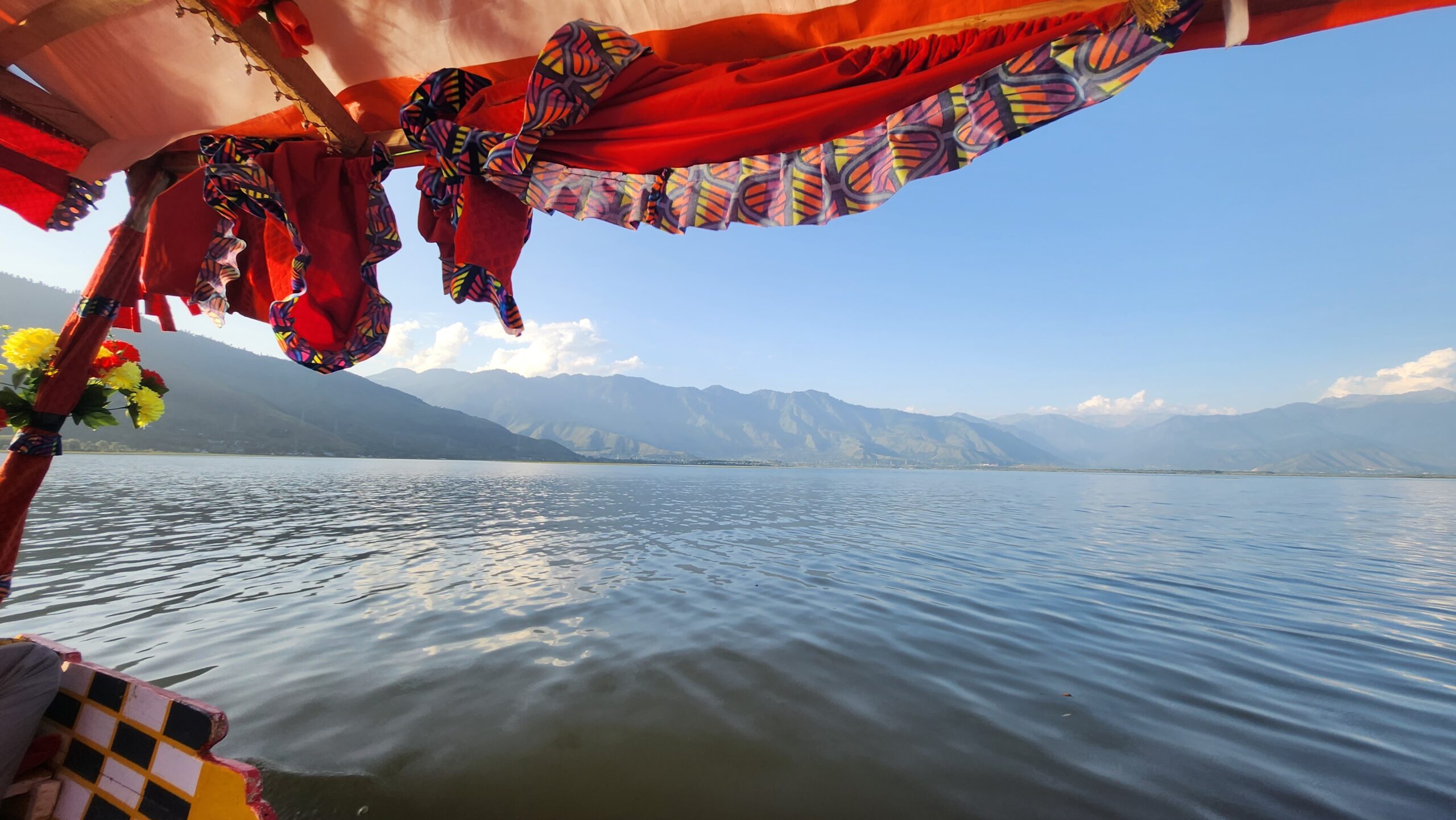
Wular Lake, possibly one of the largest freshwater lakes in South Asia, captivated me. Despite its grandeur, it remained underrated compared to the overcrowded Dal Lake. A part of the Kishanganga River flowed into Wular Lake. Danish, familiar with the area, guided us to the perfect spot, where we could hitch a shikara ride. The approach road to the lake, lined with trees and a canal transporting river water, enhanced the scenic journey. On reaching the lake’s shores, Danish helped to negotiate a fare for an hour-long ride. There were only couple of shikara’s, reflecting the limited tourist influx. We refrained from excessive bargaining, mindful of the locals’ livelihoods. The beautifully adorned, motorized shikara provided shade from the hot sun as we glided through the lake.

The two men steering the shikara were full of stories about local habitat, history, migratory birds, etc. but I was totally absorbed in the natural beauty surrounding me. Despite spotting some distinctive birds, I couldn’t identify them.
The season’s water chestnuts (singhada) were a delightful surprise, and the they halted the shikara to pluck and peel them for me. The smallest water chestnuts I’d ever seen were sweet in taste.
Imagine floating in the middle of one of the largest lakes in South Asia, surrounded by nature’s brilliance, a moment I wished could be captured by a drone.
Dal Lake, which may be less than one-tenth of its size, is crowded with overflowing tourists, boat hawkers, and encroached with houseboats and other constructions on its sides. The Wular Lake, I thought, deserved more attention on the tourist circuit, offering economic benefits to a wider area. Our conversation shifted to the Wular Lake’s challenges—encroachment and weed pollution. Despite some conservation efforts initiated by the government, there remained scepticism about the direction and adequacy of these measures. The surreal experience of ferrying around the lake left a lasting impression.

I inquired with the two men if there were any crocodiles in the lake; they chuckled and assured, “no.” This newfound confidence inspired me to dip my hands into the water as the shikara gracefully glided through the lake. The shikaras, delicate pieces of art, responded to my every movement. The moment I gently turned to immerse my hands in the cool water, the shikara leaned with a charming grace, creating an intimate dance between us. The thrill of the gentle sway was more exhilarating than the world’s best roller coaster ride. Even on a hot, sunny day, the water in the lake embraced me with its refreshing chill.
As we alighted the shikara and settled the fare, two young girls on a scooty caught my attention. The masked one, possibly very pretty, seemed to communicate to me through her eyes. As I sat in the car and we started to drive back, our eyes followed each other. I did not notice the other girl who was probably too busy negotiating the fare. A moment of unspoken connection, but destined to pass.

Since it was still daylight, Danish suggested a visit to a dargha on a nearby hill. Though not keen on religious shrines, the prospect of a scenic view from the top enticed me.
En route, we stopped for kulfi falooda from a roadside vendor. The watery kulfi failed to impress, but the UPI payment option showcased the revolutionary reach of digital transactions, potentially transforming the financial landscape for marginalized individuals.
The road to the dargah unfolded just opposite from where the kulfi vendor had parked himself. We took the turn and embarked on our drive, covering about 100 meters before Danish brought the car to a stop. He seemed to be conversing with someone on the road, gesturing them to join us. “Aap pichhe baith jaye,” he said. It was a rare moment, as Danish had been cautious about giving lifts to strangers during our trip. This time, an elderly man had sought assistance. Danish explained that the road to the dargah was steep, and the old man wouldn’t manage it easily. Although I hadn’t noticed the old person initially, I trusted Danish’s judgment. The old man settled in the rear end of the Scorpio SUV, the luggage compartment.
As we resumed our journey, we could hear the old man murmuring to himself, uttering random words in English. Danish and I exchanged glances, choosing to ignore his mutterings. Soon, another elderly man signalled us for a lift. The old man at the back of the car exclaimed, “isko leko, isko mere se bhi jyada zarurat hai” (take him, he needs it more than I do). Confirming they were companions, Even before Danish could welcome the second old man into the car, the old guy was already trying to open the back door to jump in. Danish and myself were amused to see the old Per baba’s excitement to join his fellow companion. Probably he had seen him getting into the car earlier. Now, with two peer babas in the back of our car, our journey continued.
The elderly passengers engaged in conversation amongst themselves, the first baba updating the second, about my origins. To my surprise, he knew I was from Mumbai without any of us uttering a word. He also updated his companion that I had health issues, specifying arthritis. As the two babas conversed in their mysterious ways, I remained stunned. Danish and I decided to maintain silence wondering about their supernatural powers.

The road up the mountain was both long and steep, and it dawned on to me that these babas wouldn’t have made it on foot. Scaling heights, the vastness and beauty of Wular Lake unfolded with every turn. To describe the lake as huge wouldn’t capture its true magnitude. The flow of the river into the lake, a road leading nowhere through nearby mountains, all under the sunset’s enchanting atmosphere—each moment was a testament to God’s creation.


As we reached the dargah’s parking lot, Danish parked the car, and we all disembarked. I rushed to the back of the car to confirm the existence of our mysterious passengers. They were indeed old and feeble. I sought their blessings and asked if I could take a photograph with them, still in disbelief.
I immediately checked the photograph in the camera, to confirm their existence, and I realized it wasn’t just my imagination.
I entered the dargah, which belonged to Baba Shukoor-u-din, a holy saint who had settled in this faraway place. Photography was prohibited, but within the glass enclosure, the dargah was visible to both males and females on either side of the partition.
After spending some quiet time, I stepped out to find the two peer babas sitting in the courtyard. One of them rose to bless me, and my mind found solace in their presence.
Danish dropped me back at the resort, and he left to spend the night with his aunt’s family nearby. We planned to start the next day at 10 am. After ordering dinner, I retired to bed, overcoming the initial irritation caused by the squeaking bed. The next morning, I woke up early to enjoy the resort’s garden lawn. Breakfast was ordered, and I invited Shaulat, the resident manager, to join me. As we conversed, Shaulat shared that this property, owned by a doctor’s family, couldn’t undergo many modifications because of it’s heritage tag.
Our conversation drifted to beautiful locations in Kashmir, with Shaulat recalling meeting his then-girlfriend in Doodhpatari, making it his favorite scenic spot in the region. Danish arrived to pick me up, had tea, the hotel staff loaded my luggage, and we bid farewell to Wular, heading towards our next destination—Lolab Valley.
Day 6: Lolab Valley
Gallery


Sukumar Jain, a Mumbai-based finance professional with global experience, is also a passionate traveler, wildlife enthusiast, and an aficionado of Indian culture. Alongside his career, which includes diverse roles in international banking and finance, he's working on a wildlife coffee table book and enjoys sculpture and pottery. His interests span reading non-fiction to engaging in social and global networking.