You need to be truly fortunate to weave a tapestry that embraces the top four National Parks (NP), within the illustrious Tiger Capital of India. A mere three days in advance, the stars aligned for this extraordinary venture. Unfortunately, we were unable to secure a safari for the fifth NP to complete the perfect circuit, but I had no trace of regret. Instead, I found solace in counting the blessings that adorned this unique odyssey.
Planning the trip & Route:
Mumbai – Varanasi – Khajuraho – (Panna NP) – Bandhavgarh NP – Kanha NP – Pench NP – Satpura NP – Bhopal – Mumbai
While I may not consider myself a fervent tiger enthusiast, the allure of venturing into the heart of the jungle, inhaling the very essence of the forest, captivates me. Amidst the cacophony of a vibrant forest, there exists a divine tranquillity, an oasis of serenity that beckons me time and again. For me, a sojourn into the wilderness is an invitation to immerse myself in a distinct ecosystem. The intricate symphony of communication that reverberates through the entire jungle is nothing short of mind-boggling, a testament to how its inhabitants coexist seamlessly with their surroundings. It’s a magnetic force that keeps pulling me back into its embrace.
The pivotal question lingers: Are we attuned to hear and appreciate it? The rule of the game in the jungle is dictated by animal instinct, a relentless cycle of eat, drink, and sleep that propels the very essence of its existence. This cycle, though universal, takes on unique rhythms for each inhabitant. Some (the “prey”) must keep watchful eyes open while they dine, while others (the “predator”) need to remain vigilant to satiate their hunger. Yet, the underlying truth remains unchanged—they all partake in the circle of existence, bound by the common threads of eating, drinking, and sleeping. Another shared trait between the animal kingdom and humanity is our inherent territorial nature.
Timeless Beauty Carved in Stone: Exploring the Majestic Khajuraho Temples
Day 1: Mumbai – Varanasi – Khajuraho – (Panna NP) – Bandhavgarh NP
Khajuraho Airport – (via Panna NP) Bandhavgarh NP: 255 kms / 5 hrs
The closest gateway to the enchanting Bandhavgarh National Park is Jabalpur Airport. However, the flight tickets from Mumbai to Jabalpur carried an astronomical price tag. Neha, Suyog, and myself -decided to embark on this journey via Varanasi, eventually landing in Khajuraho. The fares to this mystical route were a mere 50% of the Jabalpur alternative, plus the added allure of exploring the spiritual Varanasi and the architectural marvels of Khajuraho.
Our sojourn paused at Varanasi during a two-hour flight layover. The moment our feet touched the Varanasi soil, Neha, proposed a quick escapade into one of the world’s oldest cities. Armed with boarding passes and luggage destined for Khajuraho, the city’s ancient whispers beckoned us. Consulting the locals, we discovered that the city centre and the iconic ghats along the sacred Ganges were a considerable distance away, with unpredictable traffic patterns threatening our timely return. When hope seemed to wane, Neha, the harbinger of ingenious ideas, struck again. “Why not venture to the nearest dhaaba and savor some local delights?” she suggested. With an audacious spirit, we hailed a taxi driver willing to ferry us to the dhaaba and back within the hour. While the price for a mere 2-kilometer spin seemed steep, the promise of added joy made it a worthy indulgence.

At the dhaaba, amidst the rustic charm, we indulged in pani puri, aloo chaat puri, and tamatar chaat, savouring every bite as if time stood still. On our return, the taxi driver, sensing our zest for local flavours, recommended another stop for the famed khulaad chai, creating a delightful finale to our impromptu escapade. The chaats at this roadside dhaaba near the airport were decent, but tales of the legendary ghats’ chaats lingered in the air. A well-planned itinerary might have allowed us to spend a day or two exploring the sacred Varanasi, a missed opportunity we noted for future journeys.
The journey from Varanasi to Khajuraho unfolded in a swift, practically empty flight, taking off a commendable 15 minutes ahead of schedule. Ravi, the designated taxi driver, awaited us at Khajuraho Airport, ready to transport us first to the famous temple complex and then onwards to the lush embrace of Bandhavgarh National Park. Suyog’s meticulous instructions, our logistical maestro, unfortunately, had slipped through the cracks, lost in translation between the taxi owner Raja and Ravi (Raja’s younger brother). After 30 minutes of driving, an innocent inquiry revealed that we were headed straight to Bandhavgarh, bypassing the anticipated temple detour. Swift decision-making led us to backtrack for the temples, a detour that cost us an hour but one we unanimously deemed worthwhile. The temple complex, a mere 15 minutes from the airport, unfolded as a testament to Khajuraho architectural grandeur and cultural richness.

If your destination is the Khajuraho Airport en route to Panna NP or Bandhavgarh NP, here’s a compelling suggestion: carve out an overnight sojourn to explore the Khajuraho Temples. Even if you’re not a fervent temple enthusiast, the Khajuraho Temples, a UNESCO World Heritage site, deserves more than a passing glance. Ideally, set aside a full day, or even two, to truly appreciate the grandeur of this sacred sanctuary. The sprawling temple complex is divided into three sections, each unveiling a unique narrative etched in stone. As evening descends, the temple complex transforms into a stage for a mesmerizing sound and light show, an immersive experience that breathes life into the ancient stones.


Due to the influx of foreign tourists, the infrastructure in Khajuraho is excellent, ranging from high-end hotel chains to basic homestays. We were famished so we headed straight to a restaurant for lunch. After a quick lunch, we decided to explore the temple complex. The entrance to the temple complex was around a small lake, which was quite a journey for me, and I felt tired. I decided to stay back and skip the tour of the Khajuraho temple complex. Suyog had been to Khajuraho before, and he also did not fancy seeing the temples again. Neha left for the tour of the temple complex alone. Neha agreed to keep the tour short and meet us back in an hour. We still had five hours of road travel ahead of us. Suyog and I decided to stroll in the market area. After strolling through the streets, we came across an artist who was drawing and painting on paper. His work was very fine and exquisite. We spoke about his art form and how he was teaching his next generation about the art. His teenage son was with him, working on the canvas under his guidance. I noticed that his son had a speech impairment but he was good at his work just like his father. He was a quick learner. As we left his shop, I bought a small painting from him as a token of gratitude for his hospitality and sharing his story.
As sunset approached, Neha had far exceeded her allocated time. We left Khajuraho around 6.30 pm.

En route to Bandhavgarh, our journey traced the edges of Panna NP, the elusive fifth NP that eluded our perfect comprehensive circuit. Situated a mere 30 minutes away from Khajuraho airport, Panna NP, sprawling over 540 sq. km along the river Ken, presented a tantalizing glimpse of its scenic surrounds. The road carved through a ghat section, where, to our delight, a pair of Sambar – the regal giants of the deer family—stood poised on the roadside, a silhouette of magnificence against the backdrop. Their grandeur, a symphony of shades illuminated by the caress of sunlight, left an indelible mark. A favoured species in the animal kingdom, these sambars are not only a spectacle for the human eye but also a coveted choice for the resident tigers.
Our journey unfolded during the vibrant week leading to Hindu festival of Dussehra, a period synonymous with Navaratri’s – nine nights. Ravi, was observing a fast throughout these auspicious days—a testament to the deep-rooted traditions prevalent among the locals. Navigating through small villages in Madhya Pradesh, we encountered sparse traffic, bypassing the only major town on our route, Katni. Concerned for Ravi, who had driven for five hours from Bandhavgarh and now pressed on without sustenance, we engaged him in conversation to keep fatigue at bay. Our arrival at the resort, around 11 pm, marked the end of a long day. Exhausted, I succumbed to the allure of sleep, knowing an early morning safari awaited with the alarm set for 5 am.
Bandhavgarh NP offers a diverse range of accommodations catering to various budgets. The mid-range resorts, in particular, boast decent lodgings and commendable overall service, with the only wildcard being the variable of food quality. Booking through a reference ensures not only a comfortable stay but also extra care and attention. Subash, caretaker of the resort, epitomized humility, responding to every small request with a cheerful “ho jayega, Sir”. The essence of hospitality lies in the art of meeting unique needs, accommodating quirky habits, and fulfilling unusual requests, all without a hint of complaint. At times, smaller resorts and homestays employ local youths for various odd jobs during school or college holidays. In the spirit of gracious travel, a generous tip for the staff may seem a small gesture in the overall travel budget for you, but for them, it translates into a meaningful acknowledgment of their efforts, making your journey a truly humbling experience.
Untamed Splendour: Exploring the Mystique of Bandhavgarh National Park
Day 2: Bandhavgarh NP
Morning Safari: Tala Zone & Evening Safari: Khitauli Zone
After a restful night, we afforded ourselves a bit of leniency with the wake-up alarm, considering the weariness from the previous day’s adventures. Running a tad behind schedule, we found solace in the attentiveness of the resort staff, who greeted us with soothing bed-tea, accompanied by few slices of toast and butter. Our elaborate breakfast, was meticulously arranged in a quaint picnic basket, poised to join us aboard the safari jeep.
Bandhavgarh National Park sprawls across an extensive 1,500 sq. km, embracing both a “core” area of approximately 700 sq. km and a “buffer” zone spanning about 800 sq. km. Within this vast expanse, the park unfolds into distinct buffer zones and three core zones: Tala, Khitauli, and Magdhi, each revealing its own tale of wilderness.. Tala, renowned and sought-after, stands as the closest zone to the village area, followed by Khitauli at a greater distance and Magdhi as the farthest outpost. The proximity of these zones, a mere 15-20 minutes apart, allows adventurers to seamlessly traverse the diverse landscapes.
The common practice in most national parks involves the division of the reserved forest area into core and buffer areas. The buffer, a designated space where limited human activities find a sanctioned presence, contrasting the sanctity of untouched wilderness in the core. Yet, nature, in its whimsical dance, often pays no heed to these boundaries. The animals, in their majestic sovereignty, traverse both realms at will, leaving us mere spectators to their enigmatic choices. While the human inclination leans towards the “core” for optimal animal sightings, the reality often surprises, as “buffer” zones sometimes offer superior sightings. The unpredictable nature of animals dictates their movement, making each safari a unique experience. In the context of Bandhavgarh, a preference for “core” safaris is recommended. Modern websites now provide insights into tiger sightings across various zones, albeit with the challenge of requiring bookings 2-3 months in advance.
Bandhavgarh NP, predominantly a sprawling grassland adorned with the majestic Sal trees, holds within its embrace a table mountain crowned with a fort and a temple. The challenging terrain led the forest department to restrict access to this mountaintop. Local lore narrates that Lord Rama, in an act of fraternal generosity, bestowed this area upon his younger brother Lakshman, thus christening it “Bandhavgarh,” where “Bandhav” signifies brother and “Garh” denotes fort. Our guide informed that a local priest stays in the temple area and performs the daily rituals. The priest occasionally travels down to the town to collect the provisions. The forest authorities allows the locals to visit the temple once in a year during the period of Janmashtami (mostly during the month of August). The view from the top of the mountain would be glorious.
In Tala zone, the famed “Statue of Trinity” locally known as “Shesh Shaiya“, unfolds a tale of divine repose. Lord Vishnu, portrayed in sandstone, reclines beneath the seven-hooded serpent Shesh Nag.

The term “Trinity” denotes the three principal deities in Hinduism, each embodying a distinct power center. “Brahma” assumes the role of the creator, “Vishnu” the preserver, and “Shiva” the destroyer. The statues of Shiva (Shivling) and Vishnu are visible, while the statue of Brahma is believed to be engulfed by the roots of nearby trees, remains obscured, assuming it was sculpted or visible. These statues, approximately 1,000 years old and carved from sandstone, must have radiated magnificence in their original state. However, the harsh weather conditions over the years have taken their toll on these sculptures. The Vishnu statue stands impressively at about 35 feet in length, and the Shivling matches this grandeur. The ensemble would have offered a spectacular view of the “Trinity.” The statues, stand as silent sentinels to bygone glory, evoking a sense of reverence.
A small pond graces the area in front of the statue podium, with local lore suggesting a constant water presence, possibly from an underground spring, ensuring the pond remains filled throughout the year. Recent restoration efforts have breathed new life into these ancient statues, which perch atop a hill. Initially planned for a visit the following day, during our afternoon safari, to escape the scorching heat, however, we decided to advance our visit to Shesh Shaiya, taking advantage of the silent and serene jungle, with ample time on our side.
Along the way to Shesh Saiya, we encountered small, man-made structures resembling dens, adorned with illegible inscriptions and art. The guide shared that these structures once served as courtrooms for local kings and, intriguingly, some as horse stables. While the exact purpose remains shrouded in history, the allure of stories woven around these structures adds a fascinating layer to their existence.
An ardent drive through the Bandhavgarh forest revealed the captivating “Ghost Tree” resplendent in the daylight. Its distinctive light coloured bark, coupled with the reddish-brown resin nodes, earns its moniker for its luminous appearance under the moonlight. Locally known as the “Gond” tree, its sap crystallizes into white or brown treasures, used to craft traditional postnatal delicacies.
Since the morning safaris are lengthy and starts very in the morning, the forest department has designated a small area within the jungle where all the jeeps stop for a short break. At around 9:00 am, we stopped for breakfast amidst the wilderness. The packed picnic basket was emptied by us in a jiffy. The toilet facilities of Bandhavgarh NP are well-maintained, a notable contrast to national parks in other states.
As the clock neared 11 am, we retraced our path, returning to the resort with a trove of animal sightings. Post-safari rituals unfolded with military precision: shower, light snacks, a brief respite, lunch, and gearing up for the evening safari, a truncated adventure from 3 pm to 6 pm.
The evening safari, exploring the Khitauli Zone, followed the road traversing the buffer zone en route to Khitauli and Magdhi. This stretch, connecting Bandhavgarh to Jabalpur / Khajuraho, occasionally blessed lucky voyagers with glimpses of wildlife. Khitauli, distinguished by its bamboo cover and expansive water bodies, presented a distinct ambiance compared to Tala and Magdhi.
The evening safaris present a captivating challenge. The relentless dance of heat and dust can wear you down, fostering a desire to close your eyes and snatch a fleeting nap amidst the rugged terrain. Alas, the wild, untamed paths offer no indulgence for such luxuries. The forest is silent between 3 pm and 4:30 pm, it gracefully embraces a serene stillness, creating an almost meditative ambiance. In this tranquil interlude, both creatures and avifauna gracefully withdraw from the stage, seeking solace in the shadows, away from the sun’s relentless gaze. A game of sheer chance unfolds as most animals retire to the cool refuge of shaded spots, making spotting them akin to uncovering hidden treasures. The thrill of witnessing wildlife in its untouched sanctuary demands to be elevated to the pinnacle of exhilaration.
The lakes, usually teeming with avifauna, were uncharacteristically silent, leaving an unexpected void. Amidst this tranquility, a group of common langurs, their long tails and agile frames a testament to nature’s artistry, caught our attention. Consuming soil for salt supplementation, these langurs displayed a unique adaptation to their habitat. In the embrace of the evening, the sun dipped below the horizon, casting the forest into an enchanting palette.
For tiger-centric enthusiasts, the day’s safaris may be deemed incomplete, but for me, the tapestry of Bandhavgarh unfolded beyond the apex predator. The lazing langurs, the audacious yet vigilant spotted deer, the regal Indian gaurs, and the splendid natural waterholes painted a vivid portrait of the forest’s intricate ecosystem.
As the night unfolded, our laughter echoed through an elaborate dinner, concluding with the soft embrace of slumber beckoning us to rest. In the stillness of the night, Bandhavgarh whispered its secrets, promising another day of enchantment beneath the leafy canopy.
Day 3: Bandhavgarh NP
Morning Safari: Magdhi Zone & Afternoon Safari: Tala Zone
The morning symphony commenced with a 5 am wake-up call, orchestrating a graceful start to our day. It was decided that Suyog would take the lead in getting ready, affording me the luxury of time to complete my morning rituals and more importantly that extra 30 minutes of sleep. Subash and his team were punctual as usual and had loaded the jeep with our picnic breakfast basket. We headed towards the forest office block to pick-up our guide. While we waited for our guide to complete bureaucratic paperwork, Neha transformed the air in our jeep into a melody-filled haven.
Humming to the tunes of old romantic Hindi movie songs, Neha’s musical interlude transcended mere humming and evolved into a dulcet low-decibel serenade. The timeless allure of old Hindi songs, evergreen as a lush forest, found appreciation even in the early chill of a 6 am morning. Perhaps it was her ingenious method of dispelling the cold and staying vigilant.
Her mellifluous voice became a magnetic force, drawing the attention of neighbouring jeep tourists. As her song concluded, an unexpected applause erupted, echoing through the dawn-lit wilderness. Neha, momentarily taken aback, couldn’t help but feel a blush of embarrassment, yet gracefully acknowledged the impromptu audience with a smiling bow of gratitude. The morning had unveiled not just a wake-up call but a vibrant overture of camaraderie and shared appreciation for the beauty of the moment


The Spotted Deer, fondly referred to as the “Chital,” graces the wilderness with its distinctive brown coat adorned with enchanting white spots. Their white under-belly and a dainty tail add to the allure, creating a canvas of natural elegance. The true spectacle, however, unfolds when the deer indulges in a playful tail wag, a whimsical dance of nature.
What captivates my admiration is the ebony ribbon that gracefully runs the entire length of the deer’s spine, an exquisite detail that renders them supremely elegant. This enchanting feature reveals itself only when observed from behind, remaining veiled in the subtle mystery of their side profile. In the grand expanse of the national park, where these splendid creatures abound, visitors often overlook their beauty. As we embarked on our safari journey, encountering various deer species along the way, each unveiling its unique charm, we delved into the fascinating realm of these graceful beings.
Researchers unveil the revelation that deer possess two types of photo-pigments (in their sight), a deviation from the human trio of Red, Green, and Blue. This peculiarity grants them a limited range of colour vision. Deer(s) can see colours, but they are practically red-green colour blind. This colour perception intricacy plays a pivotal role in the art of camouflage mastered by elusive predators like the tiger. Although I am not sure whether the Emir knows about this constraints of his prey. Deer navigate their world with a nuanced reliance on their keen ears, sensitive noses, and the vigilant network of communication facilitated by other animals through alarm / warning calls. A tiger / leopard, if strategic and clever in its approach, can remain concealed, posing an imminent threat to them. The nocturnal realm, however, unveils the deer’s advantage – superior night vision, a trait that aids in their survival.
A fascinating seasonal spectacle unfolds during the monsoon, as deer gracefully shed their antlers, only to witness their rejuvenation by season’s end. In the enchanting forest of October, these regrown antlers boast a tender nature and a shimmering coating that reflects light, creating a visual poetry akin to velvet. These nascent antlers are so delicate that a mere touch could shatter their ephemeral beauty, adding a touch of fragility to the majestic narrative of the Spotted Deer.Top of Form
In the latter stretch of our safari, we saw a regal Kingfisher perched on a pole, generously affording us the luxury of time to capture her essence. Amidst the subtle nuances that distinguish the genders of these avian wonders, this particular lady stood out, donned in a resplendent blue gown. A living testament to the enchanting world of the “white-throated kingfisher” species, a jewel commonly adorned in the vibrant tapestry of Indian forests. Not to be confused with its elusive counterpart, the “Common Kingfisher,” which, contrary to its name, graces us with its presence less frequently. Our previous encounter with a captivating pair of kingfishers in the Pilibhit Wildlife Sanctuary resonated in our memory, a testament to nature’s intricate tapestry.
Our journey through the wild also unveiled a spectacle woven by nature’s artisan – a spider web suspended delicately between the dense embrace of a bamboo cluster. The intricate design, akin to a funnel, revealed a gaping hole at its core. These arachnid architects fashion their webs with a purpose – to ensnare unsuspecting prey. As the prey grapples with the challenge of extricating itself from the sticky labyrinth, the web’s effectiveness wanes over time, compelling the spider to weave a new masterpiece. Bamboo, the swift-growing grass, stood witness to this transient artistry. A botanical marvel, bamboo plants undergo a singular flowering event in their lifetime, culminating in their demise soon after, an ephemeral dance with life and death in the heart of the forest.Top of Form
We halted at the breakfast centre around 10 am. An atmosphere of enchantment enveloped the centre, where a local tribal maestro serenaded us with the ethereal tunes of his flute. Opting to forgo our packed breakfast, we generously passed it on to our safari driver and guide, opting instead for the delectable local hot aloo bondas, palak pakodas along with hot tea with dash of ginger. As we indulged in this culinary delight, the air resonated with the harmonious strains of the flute, creating a tapestry of sensory delight that transcended the ordinary. The moment, steeped in surrealism, became a symphony of flavors and melodies, a respite amidst the wilderness.
Having delved further into the mysteries of the Magdhi zone for another hour, our souls enriched, we retraced our steps to the sanctuary of our resort. Post-safari rituals completed with a sense of fulfillment, we found ourselves poised for the encore – our second sojourn into the Tala zone. This second foray unfolded as an encounter with the usual suspects – the elegant spotted deer, majestic sambhar, the regal Indian Gaur, and more. Yet, the elusive Emir had yet to reveal itself. With just one more safari on the horizon, a quiet realization began to dawn upon us, gently nudging us to reconcile with the notion that tigers might remain elusive in the heart of Bandhavgarh. The anticipation hung in the air, a delicate balance between hope and acceptance, as the wilderness continued to guard its secrets with enigmatic grace.
Allow me to unravel the nuances of jungle safari etiquette and share a touch of philosophy as we journey through this narrative.
Embarking on a forest safari, you assume one of two personas—an individual in pursuit of life’s elusive truths within the chaotic expanse or one who has attained nirvana, finding solace in the world’s embrace. For most city dwellers investing in the safari experience, achieving a state of bliss proves challenging. The ever-present pressure of social media coerces us to focus solely on tiger sightings, overshadowing the rich tapestry of flora and fauna that envelops us. Let me extend a word of advice to those already committed to the safari trip—relax, immerse yourself in nature’s unfolding spectacle, and savour the journey. There is much more to behold beyond the tiger, and when the Jungle’s Emir reveals itself, consider it an exquisite bonus.
For those who are contemplating a jungle safari, a note of caution or, perhaps, a gentle conditioning of the mind is in order. Embarking on an extended safari vacation demands both physical and mental fortitude. It is not an attempt to instill any fear but to illuminate the intricate dance between body and mind in the heart of the wilderness. Unless you are a fervent nature lover, maintaining composure beyond the initial two days can be challenging. Frustration tends to mount quickly if the elusive Emir remains unseen in the first couple of safaris.
For those planning a 5-7 day sojourn, flitting from one national park to another, let me offer a perspective. The jungle gates open around 6 am (depending upon the season, the entry timing is adjusted by the forest authorities), demanding an early rise, usually around 5 am. The entire ecosystem (the resort staff and the forest department) operates in harmony, efficiently catering to the needs of intrepid explorers. Morning safaris prove more enjoyable as the heat intensifies only by 9 am. Venturing in an open jeep along dusty off-track trails for 3 to 4 hours, especially in hot weather, can be a stretch for any human being. In cold winter mornings, braving the chill in an open jeep poses its own challenges. Adequate dressing is paramount. For those opting for back-to-back morning and evening safaris, a fantasy of a complimentary spa may materialize as a wishful thought.
Night safaris, offer a unique experience if available in your chosen national park. The nocturnal forest, though tinged with a spooky aura, unveils a captivating world. In Maharashtra’s NPs, particularly Tadoba NP, the use of torch lights by the guides enhances the experience. Animals’ nocturnal movements, like a rabbit trailing the jeep light, add a layer of intrigue. However, in Maharashtra NPs, the tourists are prohibited from carrying their mobile phones on the safaris due to past incidents, where tourist have fallen off the jeep while taking selfie with the animals. I would seriously urge the Maharashtra forest authorities to reconsider this decision.
A silver lining in the jungle cloud of Madhya Pradesh’s NPs is their generosity – no extra charges for your trusty cameras and lenses. A breath of relief, indeed! In contrast, the wildlife havens of Maharashtra and Karnataka demand a toll for each safari voyage, an escalating fee determined by the formidable size of your lens. Oh, the quirks of capturing nature’s wonders!
Testing your mental endurance, you are instructed to maintain silence during the safari—a form of “Vipassana on Wheels”. The sole reprieve arrives during the snacks break around 9 am in morning safaris. This is the moment to talk, stretch, exchange notes with fellow travellers, and hope you didn’t miss any sightings. Greetings often begin with “dhikha kya” (did you see?). Missing out feels disheartening, to say the least. A crucial tip for first-time safari-goers: manage your liquid intake wisely, as disembarking for bio-breaks isn’t an option.
Fatigued and worn, we returned to the resort, seeking solace in a rejuvenating beer. The beer help us to quickly recover our lost calories and more importantly ignore those body pains. Conversations shifted to musings on the notion of wasting our precious lives amid city chaos and contemplating a move closer to the NPs — a common discourse after a couple of drinks. Subash, an eager listener, if given an opportunity would have had offered to swap positions with us, stood smiling to himself. After indulging in another round of a delectable dinner, we retired for the night, packing for our impending departure to Kanha NP the next day. Top of Form
Day 4: Bandhavgarh NP & Travel to Kanha National Park
Morning Safari: Magdhi Zone
Bandhavgarh NP – Kanha NP: 225 kms / about 5 hrs
We were all set for our morning safari. Our jeep driver, the indomitable Raja, possessed a spirit that could rival the wilderness itself. As the realization dawned that this particular expedition marked our farewell to the majestic Bandhavgarh, and the elusive Emir had yet to grace us with his presence, Raja declared with unwavering determination, “Hum aap ko bina tiger dikhae Bandhavgarh se jaane nahi denge.” Whether it was a vow to unveil the elusive Emir on this very safari or a subtle hint of wildlife captivity, I couldn’t discern. Nevertheless, I found myself captivated by his fervor, particularly the way he buffed eloquently about the jungle’s exquisite biodiversity.Top of Form
The drivers and guides effortlessly exchange information as they pass each other. They know each and every part of the forest as lines on their palms. When there’s nothing noteworthy to report, they don’t bother stopping; their eloquent hand waving gestures say it all. Hats off to these drivers, day after day, they navigate the same jungle, trace the same tracks, and traverse the same routes, yet somehow maintain an unwavering enthusiasm trip after trip, consistently fueled by motivation. It’s a feat not easily achieved unless one truly loves their craft. Unlike the guides, drivers bear the weight of the journey on their shoulders – steering with concentration and skill, adhering to the guide’s and tourists’ instructions without a single fret. Imagine the pressure when an alarm / warning call echoes or a creature reveals itself behind the vehicle; the driver skillfully reverses, all while tourists clamor, “Jaldi, jaldi karo!” It’s a true test of patience. In my safari experiences, I’ve observed that jeep drivers often exude more enthusiasm for the jungle drive compared to their accompanying guides. It’s the art of learning and picking up tricks of the trade on the job.
Raja, an unwavering pursuer in the quest to track down the elusive Emir. It’s as if he possesses a unique ability to sniff out the feline fragrance lingering in the air. Raja, with his ears attuned to the jungle’s symphony, listens for the tell-tale alarm calls that reverberate through the wilderness. For a novice like myself, discerning the direction of these calls seemed an impossible task, but Raja effortlessly weaved his senses together. Pugmarks on the side of the track confirmed their freshness, overlaying the tire marks. Raja was certain – the Emir lurked nearby.
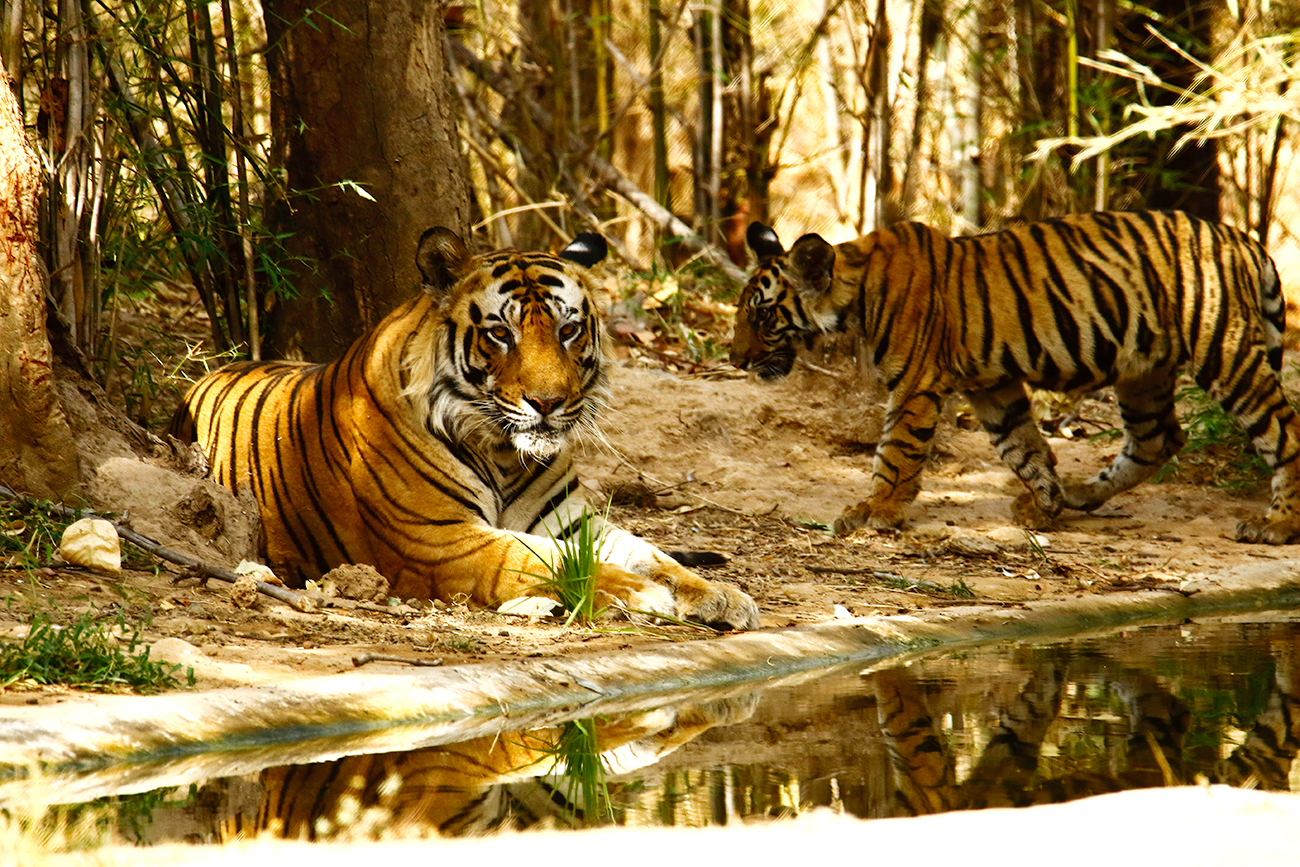
Turning the jeep around, he instructed the guide to keep a close watch inside the bushes along the jeep track route. And there she was! The Royal Bengal Tigress, “Dotty ki Bacchi“, basking in the bamboo’s shade just meters away from the jeep track. While our view was clear, the shaded setting challenged photography. Undeterred, the tigress acknowledged our presence with yawns, licks, and tail wags. Raja revealed she was a fearless young tigress, yet to undergo her naming ceremony.
As more jeeps joined, our collective presence began to disturb her peace. Rising gracefully, she embarked on a stroll. Raja, confident in his knowledge, predicted her emergence from the jungle to a particular spot. Eager to keep pace with her, I would have had preferred that Raja followed her strides. Yet, when surrounded by friends and seemingly over-smart guides, one must yield to their wisdom. All the jeeps seemed to share this unspoken knowledge and had gathered at the anticipated spot, where she would surely emerge and cross our path. We waited patiently for 15–20 minutes, but she had outsmarted us, vanishing into thin air. Animals, even the youngster like our very own “Bacchi” possess a cunning intelligence learned from her mother, “Dotty“, to outsmart the predictive humans. Although for us it was “Mission Accomplished – Bandhavgarh”, albeit with a touch of wild magic.Top of Form
It was the bittersweet moment to bid adieu to the captivating embrace of Bandhavgarh. Across the three enchanting core zones, the topography and ecology weave a tapestry, providing a holistic haven for the regal denizens of the wild. The Department of Forest shoulders a commendable challenge—nurturing and safeguarding this verdant expanse. Yet, it transforms into an alluring assignment, a dance with nature where understanding the nuanced needs of the animal kingdom takes center stage. The orchestration involves not just meeting those needs practically but also a perpetual cycle of assessment, facilitation, implementation, and corrective measures. All performed with a delicate finesse to maintain a harmonious equilibrium between the realms of humans and animals.
Subash and his spirited team had left no stones unturned to elevate our stay to an indulgent odyssey. As we reluctantly left, we could not thank Subash and his team enough for making our stay comfortable from delectable feasts to impeccable service, their hospitality was nothing short of a maharaja-style treatment, warranting a special acknowledgment.
We found ourselves trailing behind our schedule by a modest 30 minutes. Ramesh, the elder brother of our trusty chauffeur Ravi, who had ferried us from Khajuraho, stood patiently awaiting our departure. With a lengthy journey looming ahead, Subash, ever the provider of thoughtful gestures, had prepared a tantalizing lunch parcel for us — a delightful ensemble of aloo parathas, accompanied by curd and pickles. It was a flavourful send-off, a culinary blessing for the road ahead.Top of Form
October 2023
Wild Symphony at Kanha National Park: Exploring the Enchanting Wonders of Barashinga
Day 4: Bandhavgarh NP & Travel to Kanha National Park
Bandhavgarh NP – Kanha NP: 225 kms / about 5 hrs
Kanha NP is divided into four core zones: (i) Kanha / Khatia, (ii) Kisli (iii) Mukki and (iv) Sarhi. The NPs are contagious piece of forest area, but in order to manage flow of tourists and ease of internal administrative works, the NPs are often divided into various zones. In some of the bigger NPs, one or more zones can be accessed through a common gate.
Kahna and Kisli zones can be accessed through a common gate – “Khatia Gate”, while Mukki and Sarhi have “gates” dedicated for themselves under their nomenclature respectively. So my advice is to first book your safari’s based on your preference (and more importantly the availability) and then select your accommodation, which should be closest to the selected “gate” or midway to two gates. Some gates are far away from each other, so please select your zones / gates carefully after considering the travel distances between your accommodation and “gates”. Probably, because of perceived complexity in selecting the zone, etc. most of the tourists settle for an off-the-rack package tour or just cover one / two gates.
While it is not officially represented, it’s technically possible that you could explore a major portion of the zone through two gates, because the forest area is common. In Kanha, you could explore a part of the Mukki zone through Khatia gate. The Sarhi zone / gate is about 90 min. drive from Khatia gate and hence often by-passed. The Kanha NP is spread over 2,000 sq. km area which includes both “core” of about 700 sq. km and “buffer” of about 800 sq. km.
Day 5: Kanha NP
Morning Safari: Kanha / Khatia Zone & Evening Safari: Kisli Zone
In the forest, deer’s and monkey’s cohabitate. They have informal system of alliance which works for mutual benefit. The monkey’s as they move on the tree or hop from one tree to another tree, they inadvertently drops fruits and leaves of the trees, which the deer can graze on under the tree. The monkeys also keeps a watch on the movement of the predators. They have a high vantage point from the trees and they can relay signals (“alarm calls”) such as the movement of the Emir. The alarm calls are transmitted by one monkey to another and soon that part of the forest can be on alert mode. Deer’s have a strong sense of smell and their alarm calls are based on their ability to trace the fragrance of the predator. Their alarm calls can warn the monkeys on the grounds about an approaching predators like leopard. Leopards can climb the tree effortlessly and can chase a monkey for the kill. Peacocks are also known for their alarm calls in the forest warning of the predators nearby. I call these alarm calls as “Alliance of Survival”. These alarm calls vary in sound, pitch and frequency of intervals, to not only distinguish the type of predator but it also varies to notify if the predator is on the move or resting near-by. I am yet to learn to distinguish the alarm calls of one animal from another, so to distinguish the variation of alarm calls from the same animal, is a second order of challenge. The guides who accompany with the jeep safari are well trained and familiar with all the sound of music which happens inside the forest. Even the jeep drivers are well versed with the animal kingdom; their skill lies in reading the pugmarks on the side lines of jeep trails and alarm calls.
Re-Discovering the Lost Kingdom of Mowgli
Day 6: Kanha NP – Pench NP – Satpura NP
Khajuraho Airport – Bandhavgarh NP: 255 kms / 5 hrs
The enchanting tale of Mowgli in The Jungle Book unfolds within the forested realms of Madhya Pradesh, India. When Rudyard Kipling penned these stories, the National Parks (NPs) we now recognize were not clearly demarcated. Perhaps, it was one vast contiguous forest, with the nearest human settlement at Seoni. Consequently, the forested expanses of Bandhavgarh, Panna, Kanha, Pench, and Satpura, all technically constitute parts of The Jungle Book’s landscape. It is much later that Pench NP has been promoted as Mowgli’s realm for tourism purposes, probably because it’s closest to the town of Seoni. It’s also essential to note that Rudyard, had not physically traversed through this part of the country while crafting these tales. Whether his descriptions stemmed from fiction or stories relayed by the travellers he encountered remains unclear.
Instead of pinpointing the exact location, it’s more crucial to grasp and internalize the subtle messages embedded in these narratives—the tales of cohabitation, the law of the land, and the essence of freedom.
As we reminisce about these childhood stories that once fuelled our sense of amusement and excitement, perhaps it’s time to reflect on them with a renewed sense of responsibility towards the environment and the world at large. The ongoing conflicts across the globe, from Russia-Ukraine to Israel-Palestine, warrant contemplation on the merits, consequences, and enduring impacts of these struggles on the broader world. Risking the label of a Modi-bhakt, I echo his resounding message —”This is not an era of war“. Profound wisdom encapsulated in a few pearls of insight.
In our formative years, we delved into the realms of Panchatantra and Jataka Tales, where stories unfolded through the interactions between humans and animals, each concluding with a moral lesson. While these ancient Indian narratives hold their place in history, the stories spun by Rudyard Kipling have garnered a distinct resonance, amplified by Walt Disney’s masterful story-telling through outstanding graphics.
Sukumar Jain, a Mumbai-based finance professional with global experience, is also a passionate traveler, wildlife enthusiast, and an aficionado of Indian culture. Alongside his career, which includes diverse roles in international banking and finance, he's working on a wildlife coffee table book and enjoys sculpture and pottery. His interests span reading non-fiction to engaging in social and global networking.